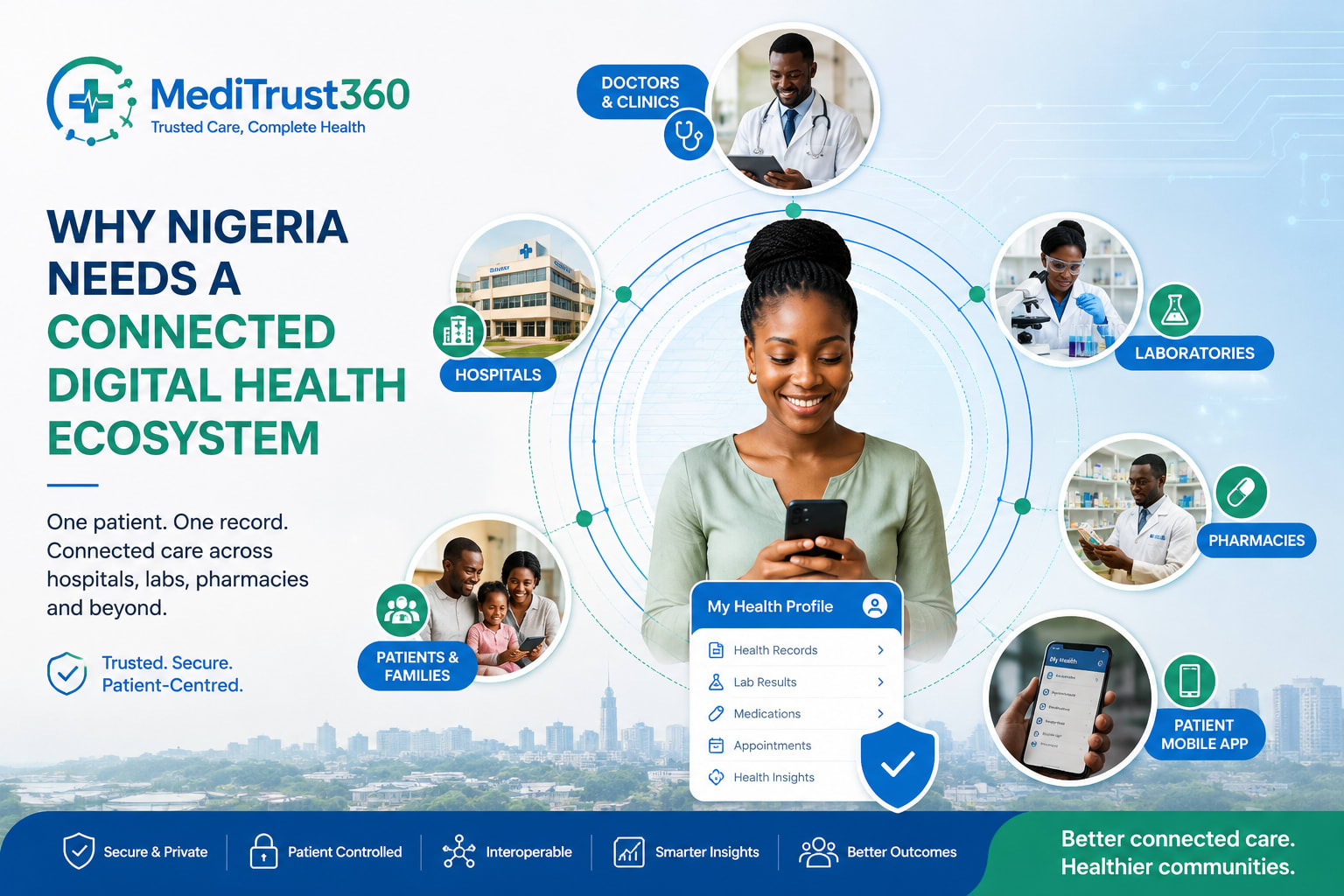
Every interaction with the healthcare system creates information.
A consultation produces clinical notes. A laboratory visit generates test results. A pharmacy dispenses medication. A hospital admission creates treatment records, prescriptions and discharge information.
Yet too often, these pieces of information remain separated.
A patient may receive care at one hospital, undergo tests at another laboratory, purchase medication from a different pharmacy and later visit another healthcare provider—with no simple way for these different points of care to securely share the information needed to understand the patient's health journey.
The result is not simply an inconvenience. Fragmentation can affect continuity of care, increase duplication and make it harder for healthcare professionals to make timely, informed decisions.
Nigeria's digital health transformation therefore needs to move beyond simply converting paper processes into digital ones.
The bigger opportunity is to build a connected digital health ecosystem.
Healthcare Is a Journey, Not a Single Hospital Visit
People rarely receive all their healthcare from one provider throughout their lives.
A patient may visit a primary healthcare centre today, a specialist hospital tomorrow, a diagnostic laboratory next month and a pharmacy several times during treatment.
Each interaction represents part of the same health journey.
But when the information generated during these encounters remains isolated within individual facilities, patients can effectively begin parts of their medical story again each time they enter a new healthcare environment.
They may need to explain previous diagnoses from memory, carry laboratory reports between facilities or search for old prescriptions and medical documents.
For healthcare professionals, this means important information may not always be available when it is needed.
A connected health system should help change this.
With appropriate consent and security safeguards, relevant health information should be capable of following the patient across authorised points of care.
The Hidden Cost of Fragmentation
Fragmented healthcare information can create several challenges.
Repeated tests and procedures
When previous results cannot easily be accessed, healthcare providers may need to repeat investigations that have already been conducted.
Incomplete medical histories
A clinician treating a patient may not have immediate visibility into previous diagnoses, treatments, medications or investigations performed elsewhere.
Medication safety challenges
Prescriptions issued by different healthcare providers may not always be visible across the patient's care journey. Connecting medication information can provide healthcare professionals with better context when making treatment decisions.
Poor continuity of care
After discharge or referral, important information may not move seamlessly with the patient to the next provider.
Limited visibility for health systems
When healthcare information remains scattered across disconnected systems, generating useful insights for planning, disease surveillance and public-health decision-making becomes more difficult.
These challenges demonstrate why healthcare digitisation should not only be about creating more applications.
It should be about enabling those systems to work together.
Patients Should Be at the Centre
A connected digital health ecosystem should begin with the patient.
Patients should be able to build a longitudinal health profile that develops as they interact with different healthcare providers.
Rather than health information being permanently trapped within individual facilities, authorised information should be capable of securely moving with the patient throughout the care journey.
Imagine a patient who receives treatment at one hospital and later travels to another part of Nigeria.
With the patient's consent, an authorised healthcare professional could access relevant information such as previous medical encounters, medications, laboratory results, allergies and other important clinical information.
The objective is not to remove hospitals' responsibility for their clinical records.
It is to make continuity of care easier while giving patients greater visibility and participation in their own healthcare journey.
Hospitals Cannot Transform in Isolation
Hospitals are central to healthcare delivery, but they are only one part of the ecosystem.
Healthcare also depends on laboratories, pharmacies, specialists, insurers, primary healthcare facilities and other service providers.
Digitising one hospital while leaving the surrounding healthcare network disconnected solves only part of the problem.
The next stage of digital health transformation therefore requires interoperability—the ability of authorised healthcare systems to exchange and meaningfully use information.
This could allow a doctor to request a laboratory investigation digitally, a laboratory to securely return the result, an authorised provider to issue an electronic prescription and the patient's health record to reflect relevant parts of that journey.
Instead of isolated digital islands, healthcare begins functioning as a coordinated network.
The Role of Digital Health Identity
Connecting healthcare also requires reliable patient identification.
A digital health identity can help link healthcare encounters to the correct patient and support the development of a longitudinal health profile.
The objective should not simply be to issue another identification number.
Digital health identity should help answer a more important question:
How can the right health information be connected to the right patient, at the right point of care, while protecting privacy and consent?
Getting this right can create a foundation for better referrals, continuity of care and health-information exchange.
Artificial Intelligence Can Support—Not Replace—Healthcare Professionals
As healthcare information becomes more structured and connected, artificial intelligence can potentially provide additional support.
AI can assist with areas such as clinical decision support, medication-safety checks, interpretation support, reminders and identifying patterns within health information.
But responsible healthcare AI should not be positioned as a replacement for qualified healthcare professionals.
Technology should strengthen clinical decision-making, not remove human responsibility from it.
The greatest value of AI may therefore come when it operates within a trusted digital health ecosystem where healthcare professionals have access to better organised and more complete information.
Good AI requires good information.
And good information requires connected systems.
Trust Must Be Built Into Digital Healthcare
Connecting healthcare information creates enormous possibilities, but it also creates significant responsibilities.
Health information is deeply personal.
Patients need confidence that their information will not simply become accessible to anyone because healthcare has become digital.
A trusted digital health ecosystem therefore requires strong safeguards around:
- Patient consent
- Authentication and access control
- Data encryption
- Audit trails
- Privacy and confidentiality
- Secure information exchange
- Accountability for data access
The question should never simply be, "Can we connect this data?"
It should also be, "Should this person have access, has the patient authorised it, and how is that access protected?"
Trust cannot be added after a digital health system has been built.
It must be part of the architecture from the beginning.
Building a Connected Ecosystem for Nigeria
Nigeria does not lack healthcare professionals, facilities or innovative technology solutions.
The challenge is ensuring that the different parts of the healthcare journey can increasingly work together.
The future should be one where a patient's health information does not disappear simply because they changed hospitals.
Where laboratory results can securely reach authorised healthcare providers.
Where pharmacies can participate in safer medication journeys.
Where referrals can move digitally between healthcare providers.
Where patients have greater visibility into their own health information.
And where aggregated, appropriately governed health information can eventually contribute to better health-system planning and public-health insights.
This requires collaboration among healthcare providers, technology companies, regulators, government institutions, insurers, development partners and—most importantly—patients.
No single organisation can build Nigeria's connected healthcare future alone.
Where MediTrust360 Fits
This is the challenge that MediTrust360 is being built to address.
MediTrust360 is an emerging digital health ecosystem designed to connect patients, hospitals, healthcare professionals, laboratories, pharmacies and other healthcare stakeholders around a more continuous patient journey.
Our vision is to build Africa's most trusted AI-powered digital health ecosystem.
The goal is not simply to digitise existing fragmentation.
It is to help create the infrastructure through which different parts of healthcare can securely connect around the patient.
Our approach includes patient-controlled health information, structured healthcare records, digital referrals, laboratory and pharmacy connectivity, medication-safety support and responsible AI-assisted clinical decision support.
We recognise that building such an ecosystem requires more than technology.
It requires trust.
It requires collaboration with healthcare professionals.
It requires strong data governance.
And it requires continuous learning from the people and institutions who use healthcare systems every day.
That is why MediTrust360's journey is being built around validation, collaboration and real-world implementation.
The Future of Healthcare Is Connected
Nigeria's digital health opportunity is bigger than replacing paper files with screens.
It is an opportunity to rethink how healthcare information moves, how patients participate in their care and how healthcare organisations collaborate.
A connected ecosystem will not emerge overnight.
But every hospital that becomes digitally connected, every patient who gains better access to their health information and every healthcare provider that can make decisions with more complete information moves us closer.
The future of healthcare should not be a collection of disconnected digital systems.
It should be a trusted ecosystem built around the patient.
Connected information. Better coordination. Safer care.
That is the healthcare future we believe Nigeria can build.
Join the conversation
Comments
Your email will not be published.
No comments yet
Be the first to share your thoughts.