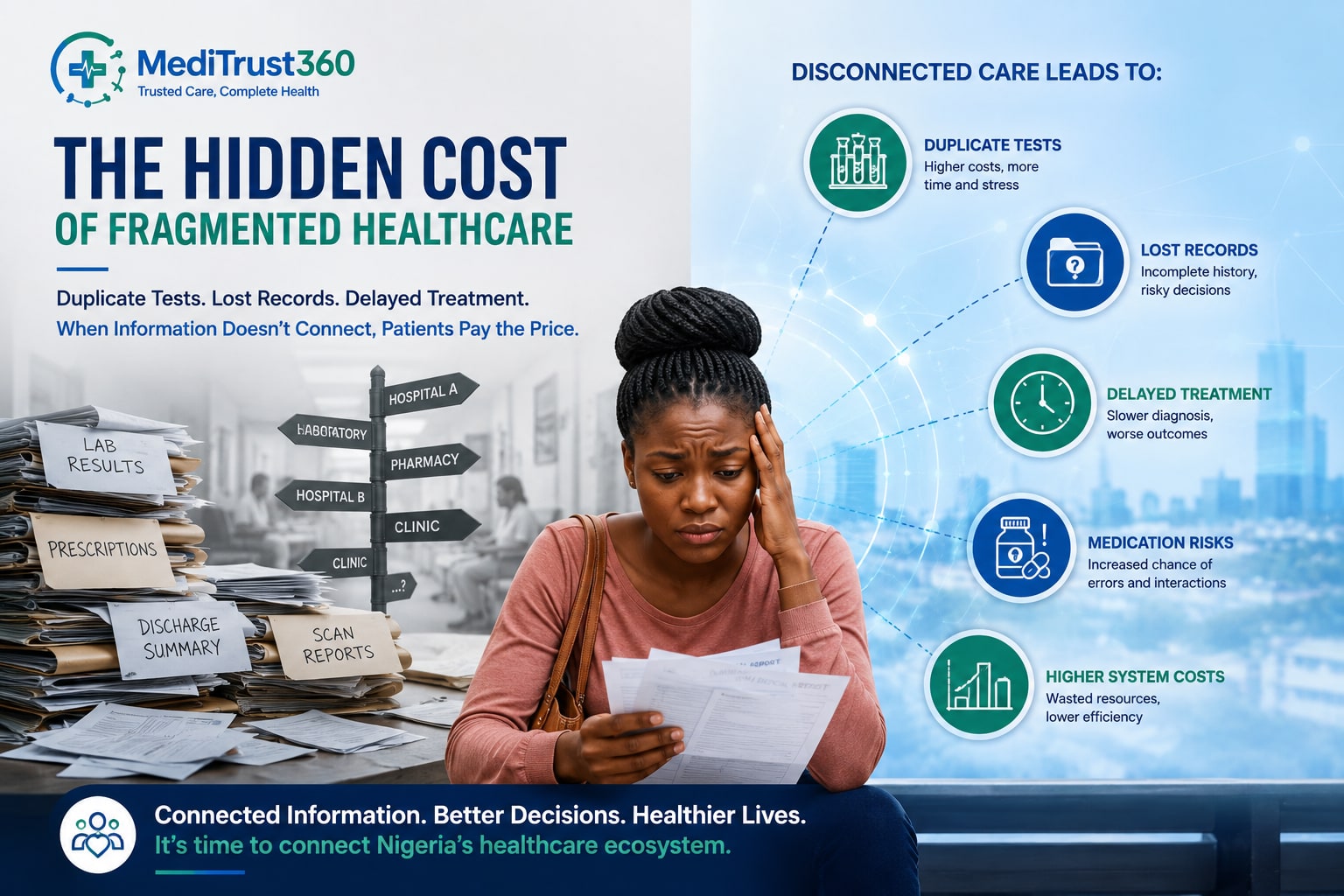
The Hidden Cost of Fragmented Healthcare
A patient visits a hospital with persistent symptoms.
Tests are conducted, treatment begins and important clinical information is generated.
Months later, the same patient visits another healthcare facility. The previous laboratory results are not immediately available. The new doctor has limited visibility into earlier treatment and must depend largely on what the patient can remember or whatever paper documents they were able to bring.
This is one of the everyday consequences of fragmented healthcare.
The problem is not necessarily that health information does not exist.
The problem is that the right information may not be available to the right healthcare professional when it is needed.
Across Nigeria, healthcare is delivered through a wide network of public and private hospitals, clinics, laboratories, pharmacies and other providers. Each plays an important role, but when information remains isolated within individual facilities, the patient's healthcare journey can become disconnected.
And that fragmentation has a cost.
When Patients Become the Connection Between Health Facilities
In a disconnected healthcare environment, patients often become responsible for transporting their own health information.
They carry laboratory reports.
They keep old prescriptions.
They take photographs of medical documents.
They explain previous diagnoses from memory.
They try to remember the names and doses of medications they have taken.
And when those documents are lost or unavailable, important parts of their medical history may become difficult to reconstruct.
Patients should certainly participate actively in their healthcare.
But there is a difference between empowering a patient to control their health information and making the patient responsible for manually rebuilding their medical history at every healthcare encounter.
A connected health ecosystem can help bridge that gap.
The Cost of Repeating What Has Already Been Done
One consequence of disconnected records is the possibility of repeating investigations.
Imagine that a patient recently completed a laboratory investigation at one facility and later seeks care somewhere else.
If the new provider cannot access or verify the previous result, another investigation may sometimes be required depending on the patient's clinical circumstances.
There are valid medical reasons for repeating tests. A patient's condition may have changed, a clinician may need more recent information or the previous investigation may not answer the current clinical question.
But when repetition happens primarily because previous information cannot be accessed, fragmentation becomes part of the problem.
For patients, unnecessary duplication can mean additional costs, additional travel and more time spent navigating the healthcare system.
For healthcare providers, it can mean making decisions without the benefit of a more complete clinical history.
Lost Records Can Mean Lost Context
A medical record is more than a piece of paper.
It represents part of a patient's health story.
Previous diagnoses, allergies, medications, laboratory investigations, procedures, referrals and treatment outcomes can all provide important context for future healthcare decisions.
When that information is unavailable, clinicians may need to reconstruct parts of the patient's history during each encounter.
This becomes particularly challenging for patients receiving treatment from multiple healthcare providers or those managing long-term conditions.
The question is therefore not simply:
"Did this patient receive care before?"
The more useful question is:
"Can the relevant information from that care be securely available when it is needed again?"
That is where connected digital health records can make a meaningful difference.
Fragmentation Can Affect the Speed of Care
Healthcare decisions depend on information.
When information is readily available, healthcare professionals can review it alongside the patient's current condition and determine the appropriate next steps.
When information is missing, additional time may be required to retrieve documents, repeat parts of the patient's history, contact another facility or conduct additional investigations where clinically appropriate.
Not every delay in healthcare is caused by fragmented records.
But improving access to relevant patient information can remove one avoidable barrier from the care journey.
This matters especially when patients move between different levels of care.
A referral from a clinic to a specialist hospital should ideally carry relevant clinical information with it.
A laboratory result should be capable of reaching the authorised healthcare professional who requested it.
A discharge summary should help the next healthcare provider understand what happened during admission.
The patient journey should not repeatedly restart simply because the location of care has changed.
Medication Information Matters Too
Healthcare fragmentation is not limited to hospital records and laboratory results.
Medication information is also part of the patient's health journey.
A patient may receive prescriptions from different healthcare providers and obtain medicines from different pharmacies over time.
Without a reliable medication history, healthcare professionals may have an incomplete picture of what the patient is currently taking or has recently taken.
A more connected system can help organise medication information and provide better context for healthcare professionals when reviewing treatment.
Digital tools can also support medication-safety processes, reminders and structured prescription records.
Technology does not replace the professional judgement of doctors or pharmacists.
Instead, it can help ensure that they have better information available when exercising that judgement.
Fragmentation Also Has a Human Cost
The consequences of disconnected healthcare are not only financial or administrative.
There is also a human experience behind them.
It is the patient trying to remember the name of a medication prescribed months ago.
It is the caregiver searching through old documents before an appointment.
It is the doctor trying to understand a complex medical history with incomplete information.
It is the family carrying laboratory reports from one facility to another.
These experiences are easy to accept as normal because they have existed for a long time.
But digital transformation gives us an opportunity to ask whether healthcare should continue working this way.
Digitisation Alone Is Not Enough
Moving from paper records to electronic systems is an important step.
But simply creating digital records inside individual healthcare facilities does not automatically solve fragmentation.
If Hospital A has an electronic system, Hospital B has another system, a laboratory uses something different and none of those systems can appropriately exchange information, healthcare may become digital while remaining disconnected.
This is why interoperability matters.
Interoperability enables different authorised health systems to exchange and meaningfully use information while maintaining appropriate privacy, security and consent controls.
The objective should not be one enormous database where everyone can see everything.
Instead, the goal should be a trusted ecosystem where the appropriate information can securely move between authorised participants when required for the patient's care.
The Patient Should Remain at the Centre
Healthcare institutions generate medical information, but ultimately that information describes the patient's health journey.
A connected digital health ecosystem should therefore give patients greater visibility and appropriate control over their health information.
Imagine being able to maintain a longitudinal health profile containing relevant information from different healthcare encounters.
When visiting an authorised healthcare provider, the patient could consent to sharing appropriate parts of that history.
Instead of starting from zero, the provider gains better context.
Instead of carrying a folder of documents, the patient participates in a more continuous digital health journey.
This does not mean removing healthcare providers' responsibility for maintaining their own clinical records.
It means creating mechanisms through which relevant information can contribute to continuity of care beyond the walls of one facility.
Building Infrastructure for Continuity of Care
Solving healthcare fragmentation requires more than developing another health application.
It requires an ecosystem approach.
Hospitals need appropriate digital infrastructure.
Laboratories need mechanisms for securely exchanging results.
Pharmacies need to participate in the medication journey.
Patients need reliable digital identities and access to their health information.
Healthcare professionals need systems designed around their workflows.
And every connection must operate within strong privacy, consent and security safeguards.
When these components begin working together, healthcare information can become more useful throughout the patient's journey.
Where MediTrust360 Fits
At MediTrust360, we believe that healthcare information should support continuity rather than become another barrier to it.
We are building toward a connected digital health ecosystem that brings patients, healthcare professionals, hospitals, laboratories, pharmacies and other healthcare stakeholders into a more coordinated health journey.
The vision is not simply to replace paper with screens.
It is to help create secure connections between the different points where healthcare happens.
This includes patient-controlled health information, structured digital records, laboratory and pharmacy connectivity, digital referrals, medication-safety support and responsible AI-assisted tools for healthcare professionals.
But technology alone will not solve fragmentation.
Trust, collaboration, interoperability, responsible data governance and real-world implementation are equally important.
That is why building connected healthcare requires participation from healthcare providers, patients, regulators, technology organisations and other stakeholders across the health ecosystem.
From Fragmented Encounters to Continuous Care
Every healthcare encounter should contribute meaningfully to what happens next.
A laboratory investigation conducted today may provide important context tomorrow.
A medication prescribed this month may matter during another consultation months later.
A hospital admission may contain information another healthcare professional needs in the future.
When those pieces remain disconnected, their usefulness can diminish once the patient leaves the facility where they were created.
Nigeria has an opportunity to change this.
The future of digital healthcare should not require patients to repeatedly rebuild their medical history from memory.
It should enable healthcare information to become part of a secure, continuous and patient-centred journey.
Because better continuity begins with better connections.
Join the conversation
Comments
Your email will not be published.
No comments yet
Be the first to share your thoughts.