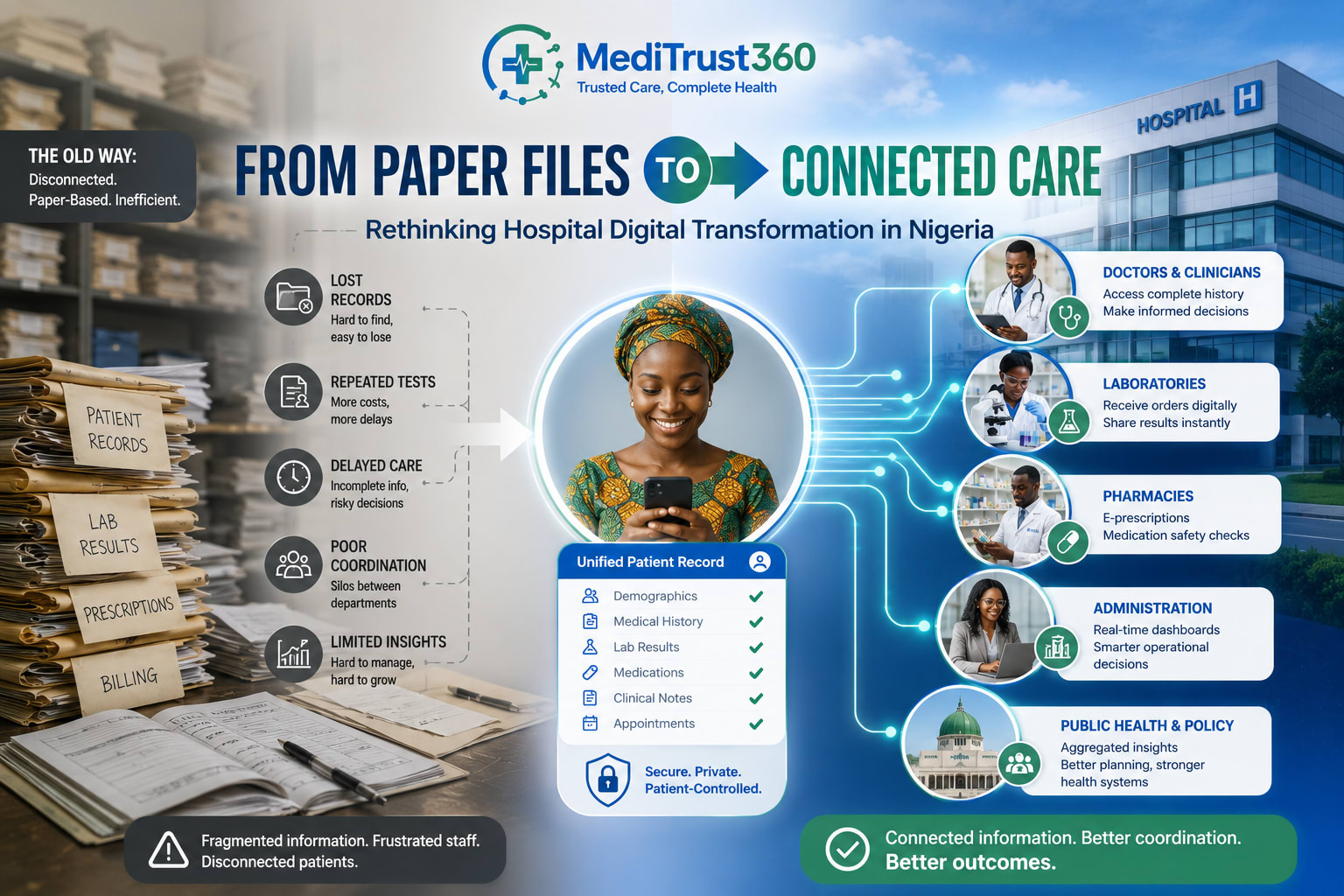
From Paper Files to Connected Care
Walk into many healthcare facilities and one thing quickly becomes clear: healthcare still depends heavily on information moving from one person, department or document to another.
A patient registers at the front desk.
A paper folder is retrieved or created.
Clinical notes are recorded.
Laboratory requests move to another department.
Prescriptions move to the pharmacy.
Billing information moves through another process.
When the patient returns, the cycle begins again.
For decades, paper-based systems have supported healthcare delivery. They are familiar, relatively simple to introduce and do not depend entirely on sophisticated technology infrastructure.
But as patient volumes grow and healthcare becomes increasingly complex, the limitations of fragmented and paper-dependent processes become more visible.
Nigeria's healthcare sector therefore faces an important question:
What should hospital digital transformation actually achieve?
The answer cannot simply be replacing paper with computers.
True digital transformation should help healthcare facilities become more connected, coordinated, efficient and patient-centred.
Digitisation Is Not the Same as Digital Transformation
A hospital may replace handwritten registration with a computerised registration system.
Another may introduce electronic billing.
A laboratory may use software to record test results.
A pharmacy may digitally manage its inventory.
These are important improvements.
But if each system operates independently, the hospital may have digitised several processes without creating a truly connected healthcare environment.
A patient can still move between departments while their information remains fragmented.
This distinction matters.
Digitisation converts information into digital form.
Digital transformation changes how information, people and processes work together to deliver better healthcare.
For hospitals, the objective should therefore go beyond eliminating paper.
The goal should be to create a connected flow of trusted information across the patient's journey.
Think About the Patient Journey
Hospital technology is sometimes designed around departments rather than around the person receiving care.
Registration has one system.
Doctors have another workflow.
The laboratory maintains its records.
The pharmacy maintains separate information.
Finance handles billing.
Management receives reports.
But from the patient's perspective, these are not separate experiences.
They are all part of one healthcare journey.
A patient should ideally be able to enter a facility, be correctly identified and have authorised healthcare professionals access the information relevant to their responsibilities.
A doctor's request for an investigation should be capable of moving efficiently to the appropriate laboratory.
The result should return to the authorised clinical workflow.
A prescription should form part of the patient's medication history.
Billing should reflect the services actually provided.
And important information generated during the encounter should contribute to the patient's continuing health record.
That is what connected care begins to look like.
The Problem With Information Silos
When hospital departments operate as isolated information systems, several challenges can emerge.
Repeated data entry
The same patient information may need to be entered multiple times by different departments.
Every repetition consumes staff time and creates another opportunity for inconsistency.
Difficult record retrieval
When information is spread across paper files, registers and disconnected digital applications, finding a complete picture of a patient's history can become difficult.
Limited coordination
Doctors, laboratories, pharmacies, nurses and administrative teams may be working with different pieces of information about the same healthcare encounter.
Weak management visibility
Hospital administrators need reliable information to understand patient activity, service utilisation, billing, staffing and operational performance.
Fragmented data makes that visibility harder to achieve.
Difficult continuity beyond the hospital
Even when information is available inside one hospital, it may become inaccessible when the patient seeks care somewhere else.
Digital transformation should progressively address these gaps.
A Connected Hospital Starts With Reliable Patient Identity
Before information can move effectively, a healthcare facility needs confidence that it is connecting information to the correct patient.
Patient identification is therefore a foundational part of hospital digital transformation.
Duplicate records, inconsistent names and incomplete demographic information can make longitudinal records difficult to maintain.
A reliable digital patient identity can help healthcare facilities organise encounters around the correct individual.
But digital identity should do more than assign a number.
It should provide a foundation through which authorised health information can remain connected to the patient over time.
As healthcare systems become increasingly interconnected, reliable identity becomes essential for continuity of care.
Clinical Records Should Support Care, Not Create More Work
Healthcare professionals already operate under significant pressure.
A digital system that simply transfers complicated paper processes onto a screen can create additional frustration rather than improve care.
Hospital digital transformation must therefore consider clinical workflow.
Doctors and nurses need systems that make it easier to document relevant information, review patient history and coordinate care.
Technology should reduce unnecessary administrative burden wherever possible.
Structured digital records can help organise information such as:
- Patient demographics
- Medical history
- Allergies
- Diagnoses
- Clinical notes
- Medications
- Laboratory investigations
- Procedures
- Referrals
- Discharge information
The objective is not documentation for its own sake.
The objective is ensuring that useful information is available to support safe and continuous healthcare.
Laboratories and Pharmacies Must Be Part of the Journey
A hospital does not function through doctors alone.
Laboratories and pharmacies are critical components of clinical care.
Yet their information can sometimes remain separated from the broader patient record.
A connected hospital should make it possible for authorised clinical workflows to interact more effectively.
For example, a clinician could request an investigation electronically.
The laboratory receives the request and records the result.
The authorised clinician can review that result within the patient's care journey.
Similarly, prescription information can contribute to a structured medication history and support appropriate medication-safety processes.
This is where digital transformation starts moving beyond administration and begins strengthening coordination around the patient.
Digital Referrals Can Extend Care Beyond One Facility
No hospital provides every healthcare service.
Patients may need specialists, advanced investigations or services available elsewhere.
Referrals therefore represent another important point where healthcare information must move.
In a paper-dependent environment, patients may physically carry referral letters, investigation results and other medical documents between facilities.
A connected ecosystem creates the possibility of more structured digital referrals.
With appropriate consent and security controls, relevant clinical information can accompany the patient to the next authorised provider.
The receiving healthcare professional gains better context.
The referring provider can potentially receive information about what happened next.
And the patient experiences greater continuity across different points of care.
Hospital Management Also Needs Connected Information
Digital transformation is not only a clinical issue.
Hospital administrators need timely information to operate sustainable healthcare facilities.
A connected hospital platform can provide better visibility into areas such as:
- Patient activity
- Service utilisation
- Staff workflows
- Billing and payments
- Laboratory activity
- Pharmacy operations
- Resource utilisation
- Operational performance
Better information does not automatically produce better management decisions.
But decision-makers cannot effectively manage what they cannot reliably see.
Digital systems can help transform routine operational activity into useful information for hospital leadership.
Interoperability Is the Next Step
A hospital can become highly digitised and still remain isolated from the wider healthcare ecosystem.
That is why interoperability matters.
Interoperability allows different authorised healthcare systems to exchange and meaningfully use information.
This becomes increasingly important when patients move between hospitals, laboratories, pharmacies, insurers and other healthcare providers.
Standards-based approaches to health information exchange can help different systems communicate without requiring every healthcare organisation to use exactly the same software.
The long-term opportunity is therefore bigger than creating digital hospitals.
It is creating connected hospitals within a connected healthcare ecosystem.
Security and Consent Cannot Be an Afterthought
As hospitals digitise more information, protecting that information becomes increasingly important.
Health information is sensitive.
Not every staff member should have access to every part of a patient's record.
A trusted digital hospital therefore needs appropriate safeguards including:
- Secure authentication
- Role-based access
- Patient consent where applicable
- Encryption
- Audit trails
- Data backup and recovery
- Privacy controls
- Accountability for information access
Digital transformation should not require patients to choose between convenient healthcare and privacy.
Security must be built into the system from the beginning.
Technology Should Support Healthcare Professionals
Digital transformation is sometimes presented as though technology itself is the solution.
It is not.
Technology is an enabler.
Doctors still provide clinical judgement.
Nurses still coordinate and deliver care.
Laboratory professionals still ensure the quality of investigations.
Pharmacists still provide medication expertise.
Hospital administrators still make operational decisions.
Digital tools should make it easier for these professionals to access information, coordinate workflows and perform their responsibilities effectively.
The best hospital technology should therefore feel less like an additional administrative burden and more like infrastructure supporting better healthcare.
Where Artificial Intelligence Fits
Once healthcare information becomes more structured and appropriately connected, additional possibilities emerge.
Artificial intelligence can potentially support areas such as clinical decision support, medication-safety checks, reminders, information summarisation and identification of patterns within healthcare data.
But AI should be introduced responsibly.
It should support—not replace—qualified healthcare professionals.
And its usefulness depends heavily on the quality, structure and context of the information available.
A fragmented healthcare environment limits what intelligent systems can safely and effectively achieve.
Connected information provides a stronger foundation.
Where MediTrust360 Fits
At MediTrust360, we believe hospital digital transformation should extend beyond converting paper processes into electronic ones.
We are building toward an ecosystem where hospitals can manage their operations while participating in a broader, patient-centred healthcare network.
The MediTrust360 approach brings together areas such as structured patient records, hospital operations, digital referrals, laboratory and pharmacy connectivity, patient-controlled health information and responsible AI-assisted healthcare support.
The long-term objective is interoperability.
A patient's healthcare journey should not become disconnected simply because they leave one facility and enter another.
Achieving this requires collaboration with hospitals and healthcare professionals to ensure technology reflects real clinical and operational environments.
Digital transformation cannot simply be imposed on healthcare facilities.
It has to be built with them.
The Transition Will Be Gradual
Moving from paper-dependent healthcare to connected digital care will not happen overnight.
Healthcare facilities operate under different circumstances.
Some already use sophisticated hospital information systems.
Others use a combination of digital applications and paper.
Some are only beginning their digital journey.
Infrastructure, staff capacity, connectivity, cost, workflow adaptation and data governance all influence the pace of transformation.
This means Nigeria does not need to wait until every hospital can implement the most advanced technology.
Transformation can happen progressively.
Start with reliable patient identification.
Build structured records.
Connect critical workflows.
Strengthen security.
Improve information exchange.
Integrate additional healthcare partners over time.
Each step can move healthcare closer to a more connected future.
Beyond Paperless Hospitals
The ultimate measure of digital transformation should not be whether a hospital has stopped using paper.
The more important questions are:
Can healthcare professionals find the information they need?
Can departments coordinate more effectively?
Can patients maintain continuity when they move between providers?
Can hospital leaders understand what is happening across their facility?
Can information be exchanged securely when appropriate?
If the answer to these questions improves, digital transformation is beginning to deliver real value.
Nigeria's opportunity is therefore not merely to create paperless hospitals.
It is to create connected healthcare organisations built around the patient.
From paper files to structured records.
From isolated departments to connected workflows.
From fragmented encounters to continuous care.
That is the digital transformation worth building.
Join the conversation
Comments 3
Your email will not be published.
Rochelle Vega
Hi there, We run an Instagram growth service, which increases your number of followers both safely and practically. - Guaranteed: We guarantee to gain you 300-1000+ followers per month. - Real, human followers: People follow you because they are interested in your business or niche. - Safe: All actions are made manually. We do not use any bots. The price is just $60 (USD) per month, and we can start immediately. You can find out more information here: http://instagrow.business/ If you are interested just complete the form on the above page. If you are not interested, no problem, just ignore this email. Kind Regards, Rochelle
Brandy Coffin
Hi List medictrust360.com in Google's Search Index so it can appear in web search results! Submit medictrust360.com now: domainsubmit.live
Joanna Riggs
Hi, I just visited medictrust360.com and wondered if you've ever considered an impactful video to advertise your business? Our videos can generate impressive results on both your website and across social media. Our videos are just $195 USD / £145 for a 30-second video ($239 USD / £179 for 60 seconds) and include a full script, voice-over and visuals. I can show you some previous videos we've done if you want me to send some over. Let me know if you're interested in seeing samples of our previous work. Regards, Joanna Unsubscribe: https://unsub.agency/unsubscribe.php?d=medictrust360.com